Henry Walke
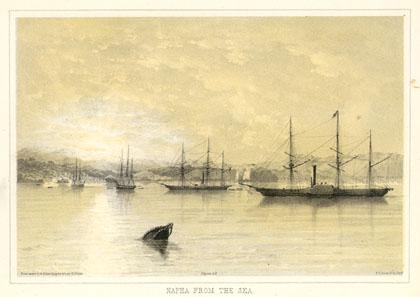
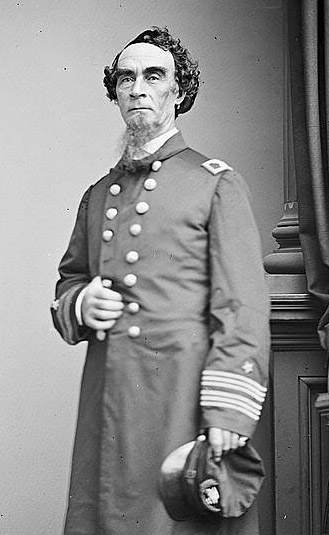
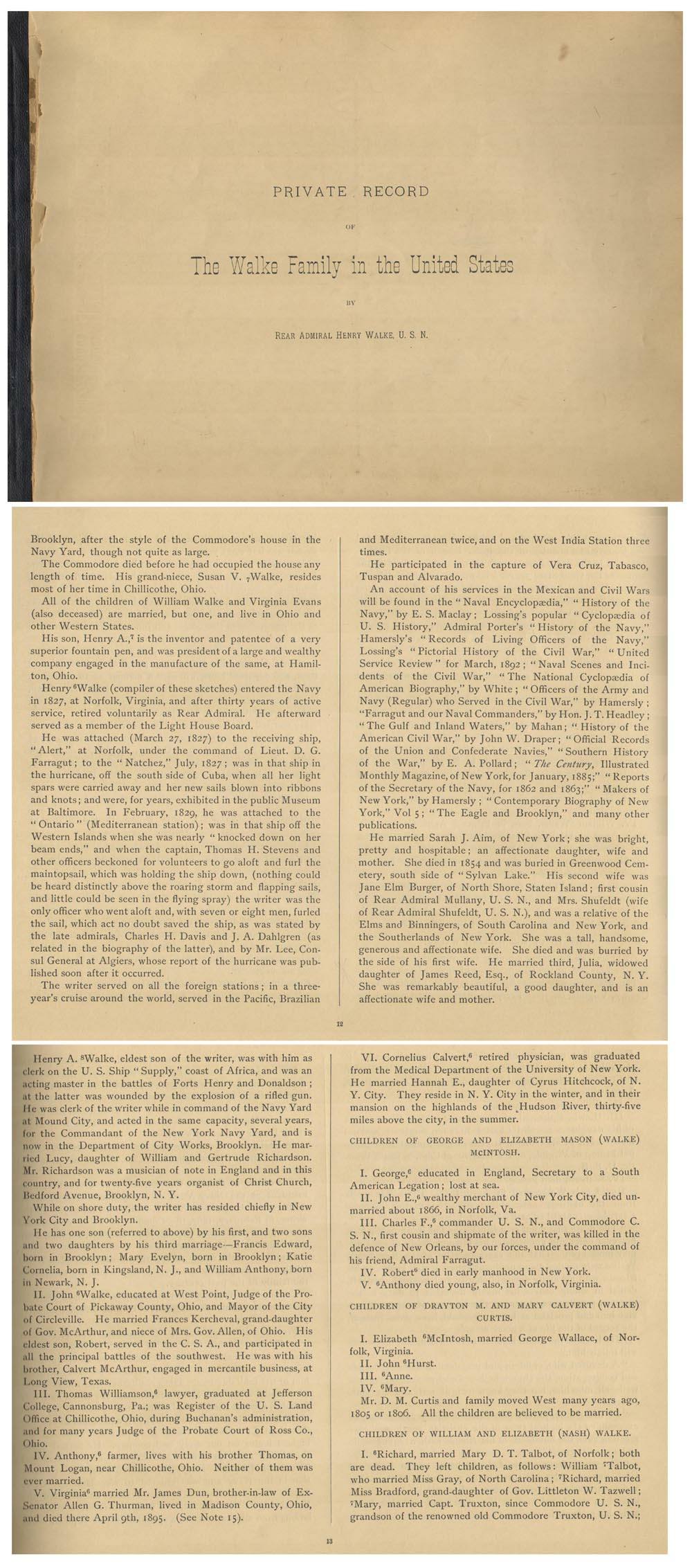
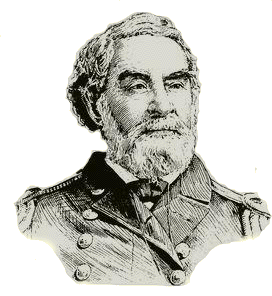 In February 1861 then Commander Walke received a General Court-Martial at Brooklyn, NY. He was the Captain of the United States Storeship Supply (a ship in the Perry Expedition to Japan) which was in Pensacola, Florida with orders to join the squadron of Commodore Prendergest at Vera Cruz because Florida succeeded from the Union. Instead of following these orders, he evacuated Union soldiers, sailors and civilians to Brooklyn where he was promptly court-martialed and convicted of charges associated with disobeying the order to go to Vera Cruz. The sentence of the court-martial was an admonition. The court-martial conviction had little adverse impact on his career. He was prompted to Captain in August 1862 and the rank of Rear Admiral in July 1870. Walke was a Union Naval hero in the Civil War and served with great distinction at Forts Henry & Donelson, Fort Pillow, Vicksburg and elsewhere. Later, Walke was dispatched to pursue Confederate cruisers in European waters. He retired from the Navy in April 1871. However, Walke continued an active life as a writer and artist until his death at Brooklyn, New York, in March of 1896. In 1877 Walke wrote Naval Scenes and Reminiscences of the Civil War. For information on this book, click here. He had also produced Naval Scenes in the Mexican War. Both of these works were particularly distinguished by the fact that he was an accomplished artist and his art work illustrated them. Both of his books are now rare. Rear Admiral Walke authored a pamphlet titled Private Record of The Walke Family in the United States. While it is undated, it was probably published in 1895 shortly before his death. There is a section in the pamphlet (pages 12-3) where he discusses his life but it has no indication a role in the Perry Expedition to Japan. The pamphlet is discussed here.
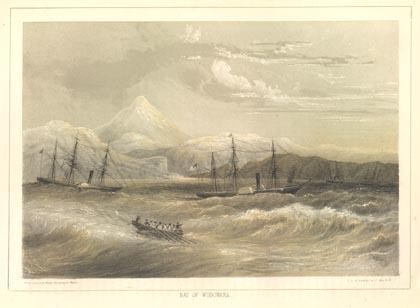
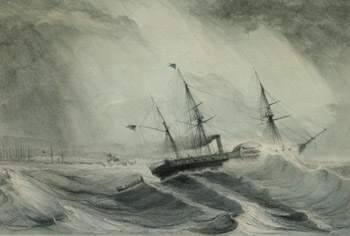
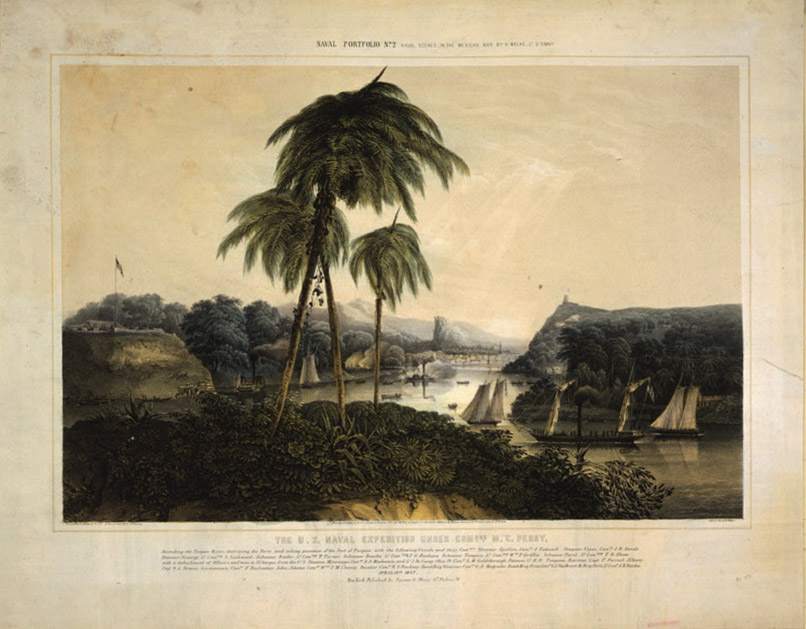
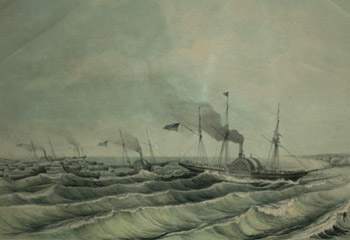
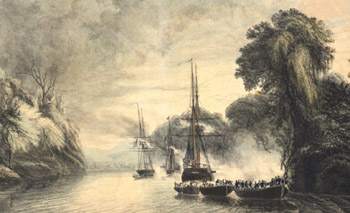
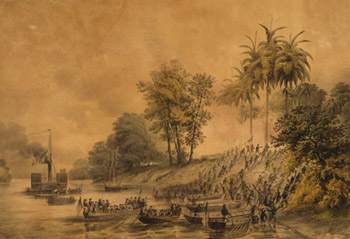
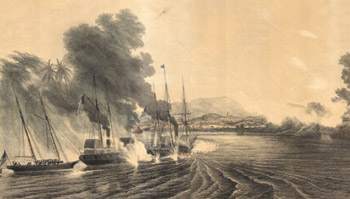
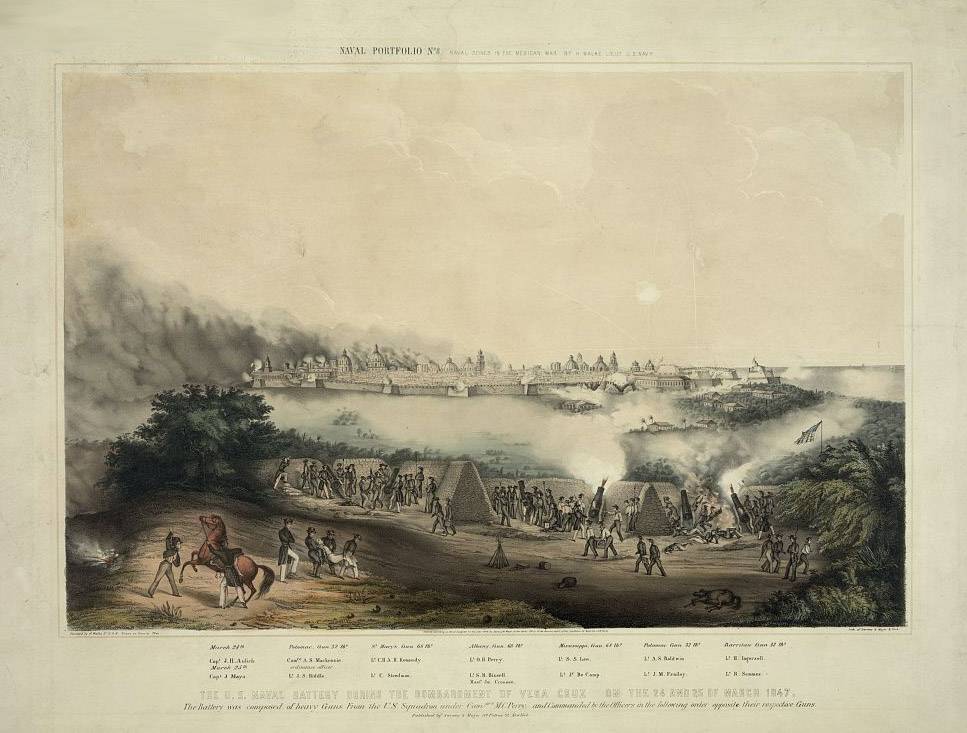
Bay of Wodowara Perhaps the rarest American Naval print series was created by then Lieutenant H. (Henry) Walke. It is a series of eight lithographs depicting Naval actions in the Mexican War in the Spring and Summer of 1847. Walke served in the war as the second in command of the U.S.S. Vesuvius, a bomb brig of the Gulf Squadron. During the war the Vesuvius participated in the blockade of Laguna and supported landings at Tuxpan and Tabasco. After serving for eight months on the Vesuvius, Walke returned to the United States in October 1847 and went on extended leave until September of 1848. On his return he immediately began work on his Naval lithograph portfolio and it was completed during this period. All of the lithographs were after original art by Walke. He personally rendered five of them onto the lithograph stones. Numbers 1, 3, 4, 5 & 7 were executed by Walke onto the lithograph stones. The others (Nos. 2, 6 & 8) were executed on the lithograph stones by others but based upon Walke's original art. "Naval Portfolio .... No. 1~8" is stated at the top of each lithograph. There is also a line of text in smaller print reading "Naval Scenes in the Mexican War by H. Walke, Lieut. U.S. Navy." The image is surrounded by a thick (2~4 mm wide) frame box. Directly below the image and within the frame box, small print text is seen at the left (lithographer - "Sarony & Major"), middle ("Entered according to Act of Congress in the year 1847 (1848)...."). Those lithographs actually executed by Walke on the lithograph stone (Nos 1, 3, 4, 5 & 7) state "Executed by H. Walke, Lt, U.S.N." or "Designed and Drawn on Stone by H. Walke, Lt, U.S.N." at the far right. When the H. Walke work was actually rendered onto the lithograph stone by another artist (Nos. 2, 6 & 8) at the far left it states "Painted by H.Walke L. U.S.N, Drawn on Stone by (name of artist)." At the bottom under the image frame box in large print is the title of the image in double line letters. This is followed by lines of smaller print with descriptive text which contains a date of for the naval action depicted. On some of the lithographs the name and address of the lithographer/publisher ("Published by Sarony & Major, 117 Fulton Street, New York.") is stated below the descriptive text. The name of the publisher/lithographer (Sarony & Major) is often found at the far right or far left under the image but within the image box. The plate size of these lithographs is generally 20 3/4 x 26 3/4+ in (53 x 68 cm). The Yale University Library lists the size of the prints as 54 x 73 cm. The image areas (including the image frame box) vary slightly but generally measure 15~15 1/4 x 21 1/4~22 1/2 in (37.8~38.5 x 53.8~56.8 cm). The most of the lithographs I would call tinted lithographs. There are executed in black & white and contain an additional tint color tint. Some of the lithographs contain more that one tint and appear to be properly classified as multi-color (chromolithographs). This work is sometimes described as a book. It apparently was issued with a folio case to house the loose lithographs. Complete sets of all eight lithographs are rarely seen. Even single lithographs are seldom seen and generally in poor condition. The Library of Congress on-line exhibit titled "Pictorial America" contains all 8 of these lithographs.
Unit of No 1 to No 7, Naval Portfolio, click here. Available for Purchase.
No. 1. "The U.S. Steam Frigate Mississippi, Comre. M.C. Perry."
|